Picture this.
A tiny hand picks up half of a picture — maybe a cat, maybe a car, maybe a strawberry.
They look carefully…
rotate it…
compare edges…
and then — the magical click:
the two halves fit perfectly.
That spark in their eyes?
That smile of “I DID IT”?
That’s exactly why 2-piece puzzle pre k worksheets remain one of the strongest early-learning tools ever created — and why AI makes them more powerful than ever.
Today’s parents, teachers, and therapists don’t want boring black-and-white kindergarten worksheets (sometimes mistakenly searched as “kindergaten worksheets”) or low-quality internet printables.
They want beautiful, engaging, brain-boosting worksheets for preprimary learners and worksheets for 2 year olds— instantly.
And now that’s possible, thanks to the AI Worksheet Generator — your personal puzzle making machine.
💕They look simple.
💡 They build the architecture of thinking.
Every time a child connects two halves, they activate essential cognitive systems:
● visual perception
identifying shapes, details, contours
● spatial reasoning
understanding how parts become a whole
● fine-motor coordination
aligning edges and holding paper
● executive function
planning, predicting, and persisting
● language development
naming, describing, categorizing
● self-confidence
success they can SEE
This is why educators include puzzle activities in almost every pre-k worksheet and early-skills binder.
They bridge the gap between play and structured learning — the sweet spot where growth happens naturally.
🧩What Exactly Is a 2-Piece Puzzle Worksheet?
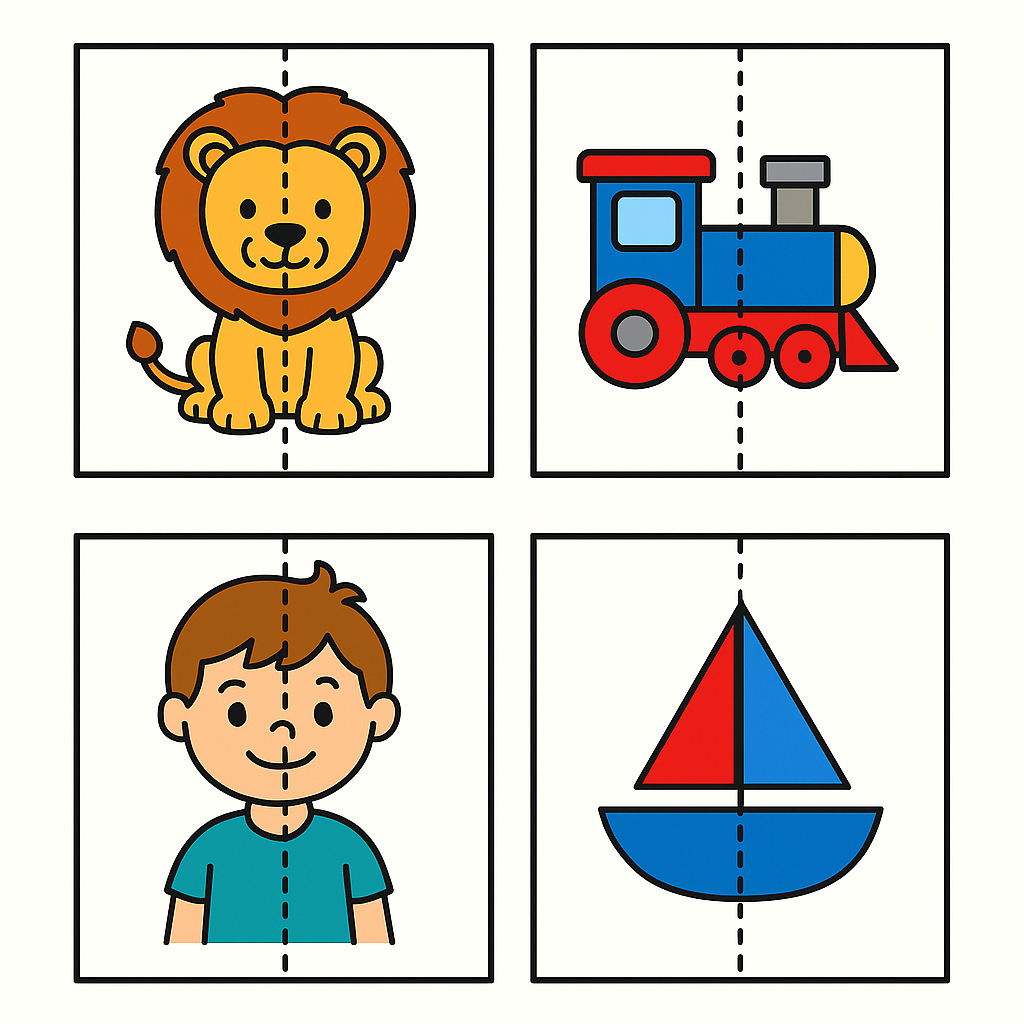
A kindergarten worksheet (sometimes mistakenly searched as “kindergaten worksheet”) becomes a powerful learning tool when each image is divided into two clear halves:
● left + right
● top + bottom
● or diagonal slices for older kids
Children match the pieces to rebuild full images:
🐶half a puppy
🚗 half a car
🍓 half a strawberry
🎈 half a balloon
The AI generator creates a perfectly clean paper puzzle PDF, parents cut along the dotted line, and the child becomes the puzzle master.
It’s tactile.
It’s visual.
It’s addictive in the best possible way.
🎯Why This Works Brilliantly for Worksheets for 2 Year Olds
Younger children thrive on simplicity + success.
A 2-piece puzzle is developmentally perfect for toddlers because:
● the goal is obvious
● success is quick
● frustration is minimal
● visual clues are strong
Every time they complete a puzzle, toddlers strengthen:
👉object recognition
👉 hand–eye coordination
👉 attention span
👉 early problem-solving
👉 confidence in their abilities
This is why worksheets for 2 year olds are most effective when they use big, clear, colorful puzzles — and the AI tool generates exactly that.
🧩For Preschool & Pre-K: Level Up the Challenge
As children grow, their brains crave more complexity.
That’s where the AI generator shines.
With one click, you can produce:
🌟diagonal cut puzzles
🌟 puzzles with trickier shapes
🌟 thematic puzzles (vehicles, pets, foods, seasons, etc.)
🌟 puzzles with subtle contours
This transforms a simple pre k worksheet into a real cognitive workout — without ever overwhelming the child.
Educators love that they can create entire puzzle packs for themes like:
● 🐾Animals Week
● 🚗Transportation Week
● 🍎Food & Nutrition Week
● 🎄Holiday Learning Centers
It’s effortless differentiation — built into the tool.
🗣How Puzzles Build Language (Even When Kids Aren’t Talking Yet)
Your typical puzzle moment becomes a full language-learning opportunity:
👧 “This is the head.”
👩🏫 “Where does the head go?”
👧 “Here!”
👩🏫 “Great! Now it’s a whole dog.”
Children practice:
● naming objects
● describing features (big, small, red, round)
● using prepositions (next to, on top, below)
● forming sentences
● answering simple WH-questions
This is why puzzles appear in so many language therapy games — they naturally support communication without feeling like “work.”
SLPs (Speech-Language Pathologists) use them for articulation, vocabulary, sequencing, and comprehension goals… all hidden inside play.
🖐Cutting + Matching = Fine-Motor Gold
When parents or teachers cut puzzles along dotted lines, they’re not just prepping materials.
They’re enabling:
● bilateral coordination
● precision cutting
● strengthening writing muscles
● improved control for future handwriting
And when kids match halves?
They refine:
● grip
● alignment
● spatial orientation
● visual scanning
This combination is why puzzles appear in every worksheets for preprimary fine-motor program.
🤖How AI Turns You Into a Puzzle-Building Superhero
Before AI, educators dug through paid for stock photos, cropped images manually, and battled formatting for hours.
Now?
You click.
AI becomes your puzzle making machine, generating:
● 2-piece puzzles
● diagonal puzzles
● thematic puzzle sets
● seasonal puzzle packs
● visual-motor puzzles
● simplified toddler puzzles
● detailed kindergarten puzzles
All delivered as clean, printable PDFs with perfect alignment.
It’s professional quality — without the professional workload.
This is why early-education creators call it the smartest puzzle builders tool of 2025.
📚For Teachers: Zero Prep, Maximum Engagement
Teachers use puzzle sheets as:
👉morning work
👉 early-finisher tasks
👉 calm-down activities
👉 literacy or math centers
👉 visual-motor warm-ups
👉 independent station work
A well-designed kindergarten worksheet (sometimes mistakenly searched as “kindergaten worksheet”) turns chaos into calm — especially during transitions.
And because the AI tool stores themes and preferences, you can build entire weekly units in minutes, not hours.
🏠For Parents: Learning in 5 Minutes (No Screens Needed)
You print.
You cut.
You hand it to your child.
They engage instantly.
Parents tell us over and over:
“Puzzles hold my child’s attention longer than any app.”
“My 3-year-old asks for more!”
“It’s the only quiet activity that actually teaches something.”
This is why worksheets for 3 yr olds almost always include puzzles: they’re irresistible and educational.
🖐For Therapists: One Worksheet, Multiple Goals
A single puzzle page targets:
● visual closure
● object recognition
● spatial language
● attention control
● bilateral motor skills
● reasoning
● problem-solving
You can also integrate it with:
● following directions
● sequencing
● descriptive language
● articulation targets
This is why puzzles appear in almost every maze and puzzles therapy binder.
One page = 8 developmental goals checked off.
🎨Why AI Puzzles Look (and Work) Better Than Free Printables
Most free puzzles online are:
🔹blurry
🔹 inconsistent
🔹 visually cluttered
🔹 poorly cropped
🔹 not developmentally aligned
🔹 not theme-matched
AI solves all of that.
You get:
👉high-resolution images
👉 clean puzzle cuts
👉 balanced spacing
👉 professional puzzle template design
👉 consistent style across packets
👉 endless variation
This is why early educators rely on AI-powered puzzles template generation — it raises quality instantly.
🌟Emotional Development: The Hidden Superpower
When a child completes a puzzle, something beautiful happens:
🌟 “I can do this.”
🌟 “I’m smart.”
🌟 “I want to try again.”
That tiny spark of success builds:
● perseverance
● self-belief
● patience
● intrinsic motivation
● emotional regulation
Nothing teaches resilience in such a gentle, joyful way.
🧩Customization = The Future of Learning
No two children learn the same way.
AI respects that.
With the Worksheet Generator, you can tailor puzzles for:
● sensory-sensitive learners
● bilingual children
● gifted pre-K students
● toddlers just starting
● children with autism or ADHD (Attention-Deficit / Hyperactivity Disorder)
● kids who need confidence-first tasks
It’s universal design in its most practical form.
🚀Ready to Create Your First Puzzle?
You don’t need design skills.
You don’t need hours of prep.
You don’t need special software.
Watch AI turn your ideas into beautiful, brain-boosting puzzles — instantly.
Watch your child light up with each completed picture.
Watch learning become joyful again.
Because when two puzzle halves meet…
the whole world starts to make sense.