A joyful journey into coordination, creativity, and confidence.
There’s something magical about handing a child a pair of scissors and watching their eyes widen with excitement. The quiet snips, the focus on the dotted path, the smile when they reach the end — this is learning in its purest form.
Practicing cutting worksheets aren’t just paper activities. They are powerful fine-motor training tools that prepare young children for writing, drawing, self-care, problem-solving, and independence.
And now, thanks to AI-powered worksheet creation, cutting practice has become smarter, more beautiful, and more effective than ever. Parents, teachers, and therapists can create custom fine motors activities for preschoolers in seconds — perfectly structured, visually engaging, and developmentally aligned.
This is the world of Cut Along worksheets — where scissors become learning tools and every line becomes a lesson.
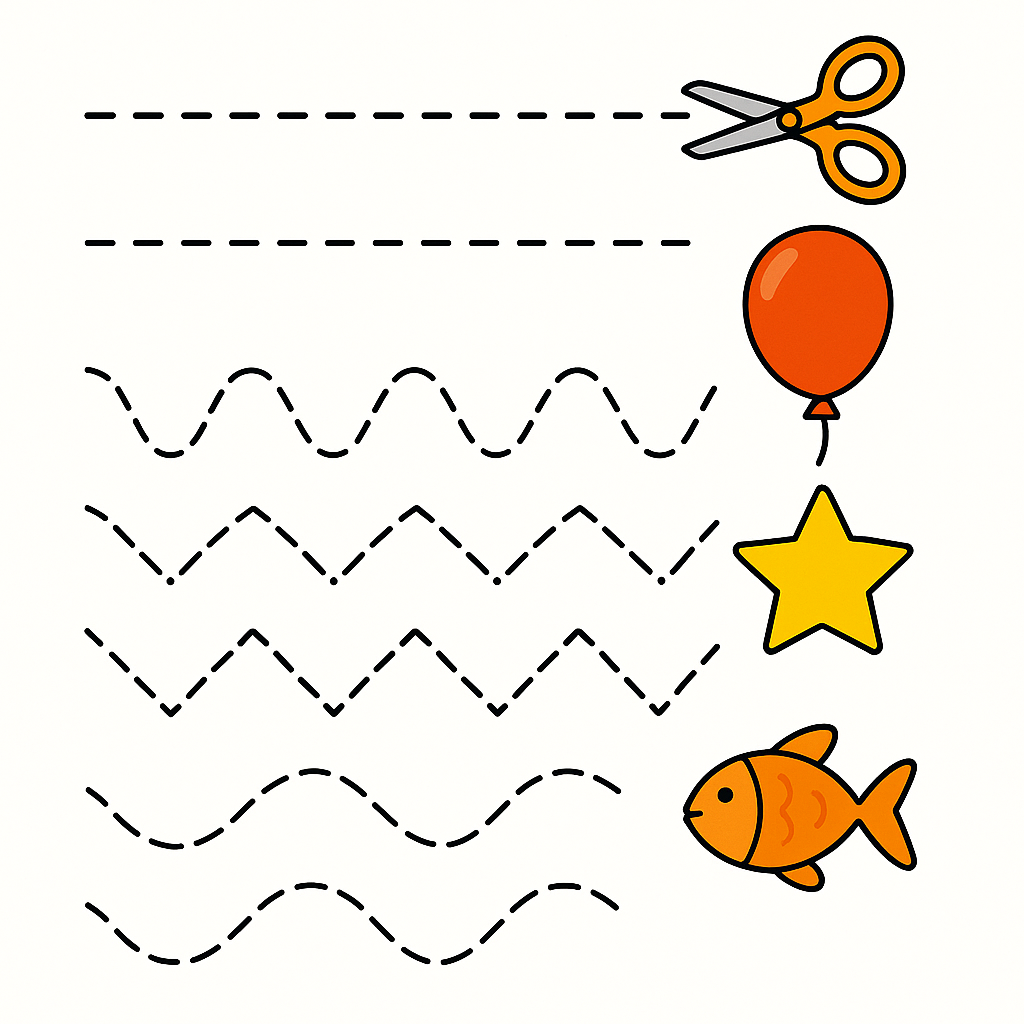
Cut Along worksheets are printable preschooler worksheets designed to guide children as they cut along lines, paths, shapes, and simple object outlines. Each page features clear cutting lines — from straight paths to wave patterns to silhouettes — allowing kids to practice control and coordination at their own pace.
These practice cutting pages for preschool come in multiple difficulty levels, making them perfect for toddlers, pre-K learners, and kindergarteners developing early motor skills. Whether the page shows a straight line across the paper or the outline of a star, children feel the thrill of “I can do it myself” with every completed cut.
And because these sheets are now AI-generated, every page has clean spacing, beautiful graphics, and age-appropriate progression.
🌱Why Cutting Skills Matter So Much
Cutting is more than a craft activity — it’s foundational brain training. When children engage with practicing cutting worksheets, they strengthen the same muscles and neural pathways required for writing, drawing, buttoning clothes, tying shoes, and using tools.
Each snip builds:
● Fine-motor strength
essential for pencil control
● Bilateral coordination
both hands working together
● Hand–eye coordination
following cutting lines visually
● Focus and attention
staying on task from start to finish
● Confidence
mastering a skill that feels “big” and independent
This is why fine “motors” activities for preschoolers play such a central role in kindergarten readiness. Before a child can write letters, they must control hand movements. Before they can color inside shapes, they must learn stability. And before complex tasks become possible, simple cut practice builds the foundation.
🧠What Happens in the Brain During Cutting
Every time a child cuts along a line, multiple developmental systems activate at once:
👁The eyes track the direction of the scissors.
🖐The dominant hand moves the scissors with steady pressure.
✋The helper hand rotates the paper.
🧠The brain anticipates direction changes, corrects errors, and adjusts speed.
This beautiful coordination is known as bilateral integration — one of the key predictors of future academic success. Practicing cutting worksheets are uniquely powerful because they blend perception, motion, and planning into one seamless learning experience.
Children aren’t just cutting paper — they’re wiring their brain for literacy, numeracy, and reasoning.
💪Building Strength for Writing and Drawing
Kids who struggle with handwriting often struggle because their hand muscles aren’t ready. Cutting develops:
● Finger strength
● Grip stability
● Wrist control
● Endurance
When young learners use practice cutting pages for preschool consistently, writing later becomes smoother and more natural. Cutting lines helps them stay steady. Curved paths teach rhythm. Object cutting introduces spatial concepts.
That’s why therapists consider cutting experiences for preschoolers essential for pre-writing readiness.
🎨From Simple Lines to Creative Shapes
The beauty of modern worksheets lies in their progression. Children can start small and grow gradually:
1.Straight lines — learning control
2. Zigzag paths — developing precision
3. Curvy waves — practicing fluidity
4. Shape outlines — connecting visual perception
5. Object contours — applying mastery in real contexts
AI tools now generate perfectly balanced cutting lines at every level. No clutter, no low-quality clip art — just clean, child-friendly paths that invite success.
👩🏫For Teachers: A Classroom Essential
Teachers love having a fresh supply of preschooler worksheets that require zero prep. With AI, entire sets of cutting lines worksheets can be created instantly — themed, leveled, and ready to print.
Use them for:
📚Morning fine-motor warmups
🧠 Stations and centers
🖐 Art prep for craft days
📘 Literacy warmups (cut, sort, paste)
Cutting ideas for preschoolers are unlimited when every worksheet can be generated in seconds. And because consistency matters, educators can finally rely on worksheets that look professional and support meaningful progression.
🏠For Parents: Quiet, Screen-Free Learning
Parents often search for activities that truly engage children without screens. Cutting pages do exactly that. They focus the child’s attention, calm their energy, and offer a meaningful challenge.
At home, these worksheets for cutting work beautifully for:
🕓After-school decompression
🎨 Creative time
📖 Pre-bed quiet activities
✈ Travel busy bags
And because Cut Along pages are printable anytime, parents never run out of ways to support learning.
💬For Therapists: A Multi-Skill Power Tool
Occupational and speech-language therapists use cut practice to target multiple goals at once:
💬Vocabulary — naming shapes, objects, actions
🧩 Spatial terms — “around,” “curve,” “left,” “right”
🖐 Bilateral coordination — steadying movements
🧠 Executive skills — planning, monitoring, adjusting
In therapy sessions, worksheets for cutting often act as bridges between motor development and language growth. Kids talk through their actions, describe shapes, and build new conceptual language while cutting.
This is why cut activities preschool specialists consider scissors among the most therapeutic tools in early childhood development.
🎯Why Children Love Cutting
Cutting feels empowering. Kids hold real tools. They make real decisions. They see real progress.
Every successful cut triggers a small dopamine reward — the neurochemical of joy and motivation. This keeps children coming back, eager for the next challenge.
And when adults celebrate their effort — “You stayed right on the line!” — the experience becomes emotionally meaningful.
This emotional connection is what turns simple cutting experiences for preschoolers into powerful confidence builders.
⚙How AI Makes Cutting Worksheets Smarter
AI has revolutionized early-learning materials. Today’s worksheet creators let adults choose:
● Line types
● Object themes
● Difficulty levels
● Page structure
Then generate perfect practice cutting pages for preschool instantly.
No more searching through low-quality printables. No more resizing shapes in Word. No more mismatched styles.
Just beautifully designed materials — clean, balanced, and developmentally aligned.
This is what makes the cutting worksheet maker feel like a true puzzle maker machine for motor skills.
🌈Creativity Without Limits
Cut Along pages aren’t just for cutting — they unlock endless creativity:
🎨Cut and paste collages
🧩 Homemade puzzles
📖 Story sequencing
🎁 Cards and decorations
Teachers and parents can mix cutting with coloring, tracing, sorting, or matching for multi-layered engagement. The possibilities expand as fast as the worksheets are generated.
💞The Heart of Learning: Connection
The most powerful moments in early childhood education come from shared experiences. When a teacher gently guides a child’s hand or when a parent quietly encourages patience, learning becomes emotional — not mechanical.
Cutting teaches attention, control, and focus. But it also teaches confidence, resilience, and the joy of achievement.
This is learning that lasts.
🌟Ready to Build Fine-Motor Magic?
With just one click, you can generate practicing cutting worksheets that strengthen skills, inspire creativity, and support developmental growth — all while keeping learning joyful and meaningful.
Strong hands.
Focused minds.
Confident learners.
All starting with a single dotted line.