When parents and teachers hear the word opposites, they often imagine something very simple:
big–small, hot–cold, fast–slow.
A cute preschool game.
A quick kindergarten warm-up.
A “filler” activity when there’s extra time.
But here’s the truth most people never hear:
💎 Learning opposites is one of the strongest early-language tools for preschoolers.
Well-designed opposites worksheets don’t just teach vocabulary. They help children:
● think and compare
● build longer sentences
● understand the world
● express their needs
● develop reasoning and problem-solving
Opposites aren’t “just words.”
They train the brain to notice differences, categorize, explain, and choose — and this is where language becomes intelligent.
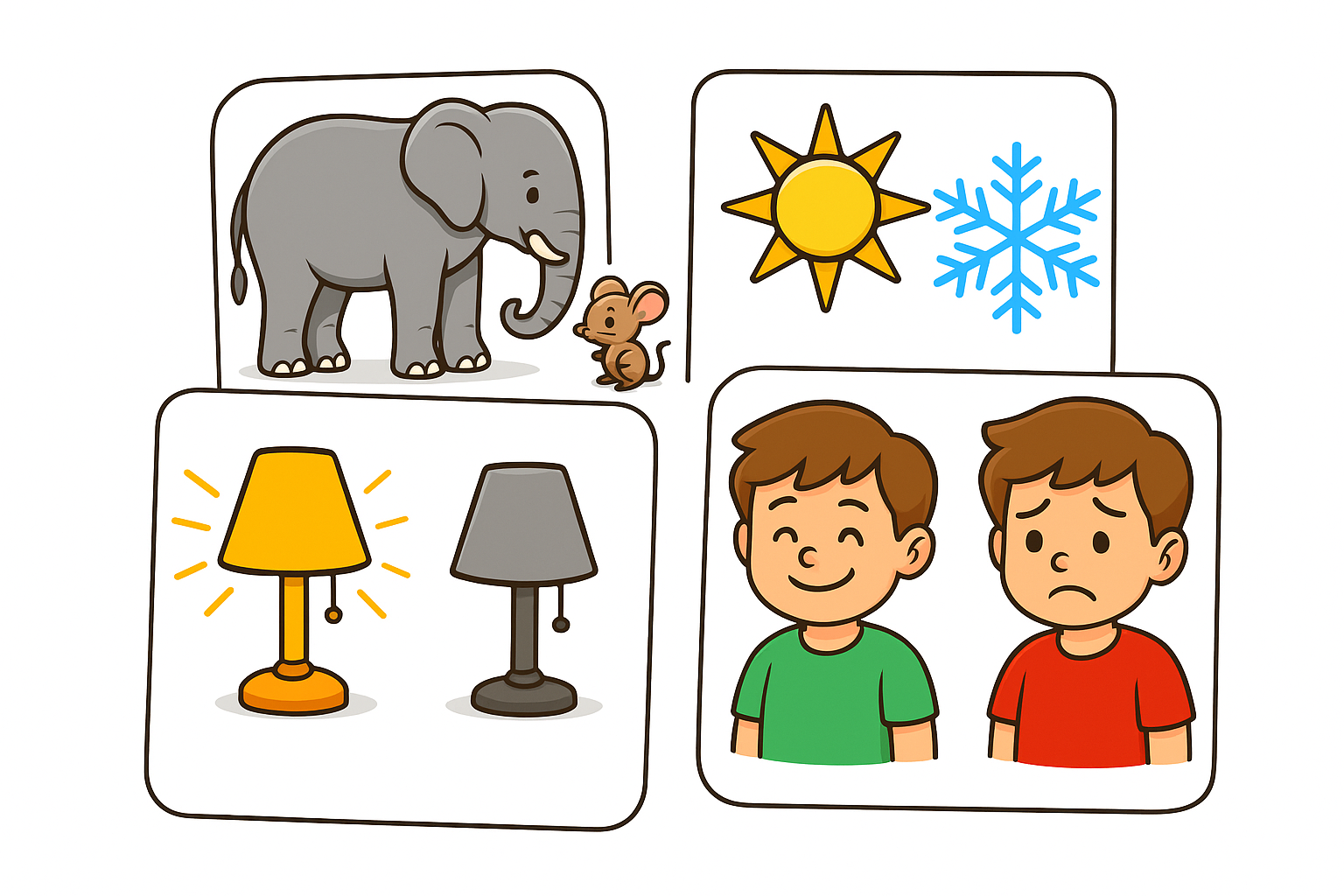
Imagine a toddler choosing between two cups:
One is empty.
One is full.
Even without words, they already sense a difference.
When they start naming those differences —
● big / small
● long / short
● wet / dry
● noisy / quiet
— they move into a completely new stage of language development.
Opposites unlock:
💡 expressive communication
(“big bear”, “cold juice”)
💡 descriptive language
(“dark room”, “fast car”, “slow turtle”)
💡 reasoning
(“this is bigger, that is smaller”)
💡 emotional vocabulary
(“happy / sad”, “scared / brave”)
💡 real-world problem-solving
(“too hot”, “too loud”)
A child who can say “cold juice”, “slow car”, or “big bear” is not just talking.
They are describing reality, asking for help, making choices, and showing understanding.
That’s why learning opposites appear in almost every preschool program, kindergarten curriculum, ESL class (English as a Second Language learners), and set of language activities for speech therapy.
💎Why So Many Worksheets Don’t Work (and Kids Refuse Them)
Parents and teachers search online for:
● preschoolers worksheet
● printable kindergarten worksheets (often misspelled online as “printable kindergarden worksheets)
● childrens worksheet
● worksheets for preprimary
● speech pathology language activities
…and quickly get frustrated:
🔹low-resolution images
🔹 cluttered, busy pages
🔹 tiny pictures no one can see
🔹 random vocabulary with no system
🔹 clipart that looks confusing or boring
🔹 tasks that are either way too easy or way too hard
Children lose interest fast.
Some worksheets even create more confusion than learning.
And educators simply don’t have time to design a new children's worksheet (often misspelled online as “childrens worksheet”) for every group, level, and theme from scratch.
💎How AI Fixes Opposites Worksheets in One Click
Modern educators are moving to AI Worksheet Generators that are built specifically for young learners.
With just a few clicks, you can:
💎generate printable opposites worksheets
💎choose skill level (toddlers, preschool, kindergarten)
💎select vocabulary category (foods, animals, toys, actions, weather…)
💎get high-quality real pictures or clean clipart
💎print instantly for home, classroom, or therapy
The result?
Worksheets that look like they came from a professional early-learning workbook — clean, visual, and developmentally appropriate.
● Children stay focused.
● Teachers and SLPs (speech-language pathologists) see real progress.
● Parents stop wasting time on random downloads.
💎What Makes Opposites Worksheets So Powerful
Every opposites task asks the child to make a decision.
They don’t just repeat like a robot — they think.
They look at two pictures and decide:
● Which is big? Which is small?
● Which is fast? Which is slow?
● Which is full? Which is empty?
● Which is happy? Which is sad?
This kind of practice builds:
💡problem-solving
💡vocabulary generalization
💡categorization
💡reasoning skills
💡working memory
💡attention to detail
💡expressive and receptive language
Speech therapists love using opposites in speech pathology language activities because they naturally create conversation:
👩⚕ “Which one is tall? Why?”
👦 “This one. It is taller.”
👩⚕ “Show me the closed door.”
👧 points correctly
👩⚕ “Can you say it?”
👧 “Closed door!”
This is real communication, not just memorizing a list.
💎Where Opposites Worksheets Work Best
Opposites are incredibly flexible and can be used anywhere learning happens:
🏠 At home
Perfect for parents who wantscreen-freeactivities that actually develop thinking and language.
🏫 Preschool & kindergarten classrooms
Teachers use opposites for:
● circle time
● small group centers
● morning work
● quiet table tasks
🧠 Speech therapy
Ideal for:
● expressive and receptive language
● autism support
● apraxia
● articulation practice
● AAC users (AAC - children or adults who use Augmentative and Alternative Communication systems)
● bilingual learners
🌍ESL (English as a Second Language learners) & preprimary groups
Opposites are an easy way to teach meaning visually, using pictures instead of long explanations.
When an opposites worksheet is clear and visual, every child can participate — by pointing, circling, matching, or speaking.
💎What’s Inside an AI Opposites Worksheet
Unlike repetitive, boring pages, AI-generated materials can include:
💡matching big/small, long/short, full/empty
💡cut-and-paste sorting activities
💡 “circle the opposite” games
💡opposites flashcards for speech therapy
💡 preschoolers worksheet
sets for home or school
💡 printable kindergarten worksheets
(often misspelled online as “printable kindergarden worksheets”) for daily warm-ups
💡 worksheets for preprimary
learners with simple visuals
💡comparison pages (hot vs cold, clean vs dirty, noisy vs quiet)
You can print several pages in seconds — and each worksheet is new.
No designing.
No formatting.
No searching folders.
💎Why Opposites Help Children Speak Faster
When a child first learns nouns, they name objects:
“car”, “ball”, “dog”.
When a child starts learning opposites and adjectives, they describe them:
💎 “big car”
💎 “fast car”
💎 “red car”
💎 “My car is bigger!”
Opposites unlock:
● richer sentences
● conversation skills
● storytelling
● comparing and choosing
● independent communication
Children suddenly move from “just naming” to sharing what they think and feel.
💎Works for ALL Types of Learners
Opposites worksheets are incredibly inclusive. They work whether a child:
● speaks clearly
● is bilingual or learning English
● is non-speaking
● uses AAC (AAC - children or adults who use Augmentative and Alternative Communication systems)
● has delayed speech
● struggles with attention
● needs simple, clear visuals
● prefers hands-on learning
Children can respond by:
● pointing
● circling
● matching cut-out pictures
● using tokens or stickers
● saying the word
● choosing from two images
For some children, opposites tasks become the first activity they can complete independently — and that confidence pushes language forward.
💎Why Educators Prefer AI Over Random Free Worksheets
Creating a good children worksheet usually means:
🔹searching for clipart
🔹 editing layouts
🔹 resizing images
🔹 reformatting pages
🔹 fixing printing issues
With an AI Worksheet Generator, that disappears.
💎No blurry images
💎No cluttered layouts
💎No tiny pictures
💎No random mix of styles
You simply:
💡choose “Opposites / learning opposites”
💡 pick a level and theme
💡 click Generate Printable Worksheets
💡 print
You can create multiple pages for one session in under a minute — and children don’t get bored, because each page is slightly different.
💎Ready to Use Opposites Worksheets That Actually Help?
If you work with:
● preschoolers
● kindergarten students
● ESL (English as a Second Language learners) groups
● children in speech and language therapy
…then opposites activities will quickly become one of your favorite tools.
No apps.
No endless prep.
No chaos.
Just smart language activities for speech therapy, preschool, and home — ready when you are.
Let children discover the world through big / small, fast / slow, hot / cold, happy / sad —
and watch their language grow naturally, page by page.