A storytelling game that helps children speak clearly, think deeply, and express themselves with pride.
A girl is baking cookies.
In the next picture, she sets the table.
Then she shares the cookies with her family.
Finally, she smiles — proud of what she made.
A child looks at these pictures, points, and says:
“She’s helping her mom.”
In that moment, something extraordinary happens.
He’s not just describing a scene — he’s building vocabulary, sequencing, grammar, empathy, and confidence.
Welcome to Describe the Picture, the AI-powered storytelling worksheet that transforms quiet observations into powerful language.
Whether you’re using it as a kindergarten worksheet, planning preschooler activities, designing materials for speech and language therapy, or guiding preschoolers activities at home, this simple tool unlocks communication in the most natural way possible.
Thanks to the AI Worksheet Generator, you can create clear, realistic 4-panel story sequences in seconds — tailored to your child’s level, interests, and language goals.
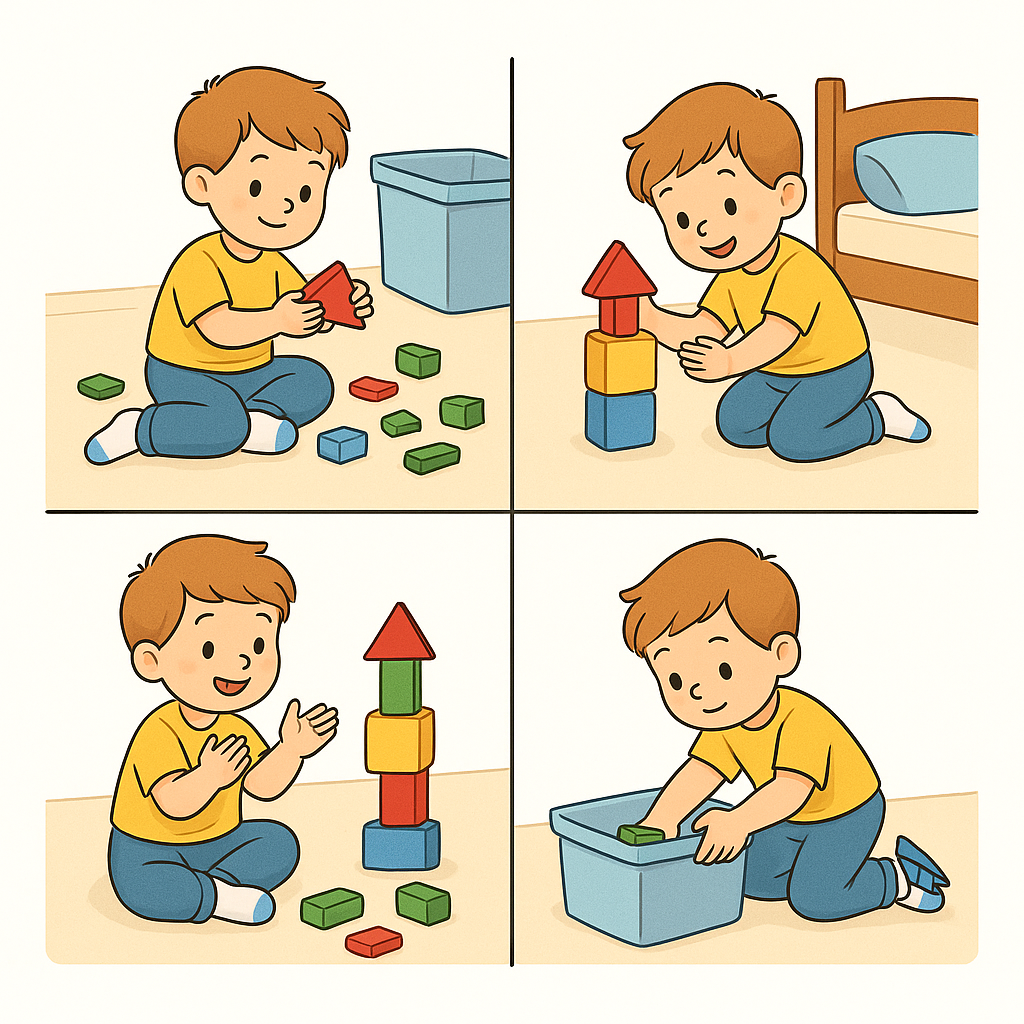
Each worksheet features four picture panels that form a short, logical, child-friendly story:
🍪Baking cookies
🐶 Walking the dog
🎒 Packing for school
🎂 Preparing for a birthday
🌳 Playing at the park
🧸 Cleaning up toys
🎨 Painting a colorful masterpiece
The images are realistic, warm, and familiar — carefully designed so children instantly understand what’s happening.
The child describes:
● what they see
● what each person is doing
● what they think will happen next
● how the story ends
This makes “Describe the Picture” one of the most powerful describe picture for kids tools available today.
🧠Why Describing Pictures Builds Strong Thinkers & Strong Speakers
When children describe images, they engage multiple cognitive systems at once:
🧩
Visual processing
They notice details, relationships, emotions, and objects.
🗣
Expressive language
They form complete sentences and choose the right words.
💭
Logical sequencing
📚
Narrative comprehension
They grasp cause and effect, motives, and outcomes.
💛
Emotional intelligence
They recognize feelings and intentions in characters.
That’s why this kindergarten worksheet is far more than a cute activity — it trains the exact skills needed for reading, writing, speaking, and social communication.
🎯Designed for Ages 2–6 — With Growth Built In
The worksheets adapt perfectly to your learner’s developmental stage:
🐣
Ages 2–3
Short, simple scenes with clear actions: eating, playing, helping.
🌼
Ages 4–5
Cause-and-effect moments:
“The ball rolled away — he’s chasing it!”
🏫
Kindergarten level
Full storytelling structure:
“She made cookies, shared them with her family, and felt proud.”
Every worksheet grows language gently — from naming to narrating.
This is why educators rely on these preschooler activities to prepare kids for reading and academic life.
👩🏫Why Teachers Love This Worksheet
Teachers use Describe the Picture worksheets because they effortlessly turn observation into communication.
Perfect for:
📘 Morning warm-ups
A soft start to the school day.
🎨 Writing & art centers
Describe first, draw second.
🧠 Circle time
Discuss the story together.
🗣 ESL
(English as a Second Languagelearners)instructionVisual prompts help non-native speakers build sentences naturally.
With the AI generator, teachers can create unlimited themes — seasons, holidays, routines, emotions — in seconds.
It’s professional, consistent, and incredibly time-saving.
💬A Speech Therapist’s Secret Weapon
Describe the Picture is one of the most effective games for speech and language therapy, used by SLPs (Speech-Language Pathologists) worldwide.
It strengthens:
🗣 Expressive language
(children practice sentence structure)
👂 Receptive language
(children retell or answer questions)
🧠 Sequencing
(beginning → middle → end)
💬 Vocabulary recall
(names of actions, objects, feelings)
🤝 Social communication
(eye contact, turn-taking, perspective-taking)
And now, therapists can generate personalized materials for speech and language therapy instantly — perfectly suited to each child’s goals.
🏠For Parents: A Screen-Free Way to Grow Language
Parents often ask:
“How do I get my child to speak more?”
This worksheet is the answer.
Print a page.
Sit together.
Ask gently:
“What do you think is happening here?”
Your child thinks… looks… and finally says something.
A sentence.
A thought.
A story.
That moment is magic — and it builds:
💬communication
👁 attention
💛 connection
🧠 confidence
These homes activities for preschool are perfect for bedtime, car rides, quiet play, rainy days, or daily speech practice at home.
No screens.
No pressure.
Just real words, real growth, real bonding.
💛The Emotional Power of “Being Heard”
Every time a child explains a picture and an adult listens, nods, and says:
“Tell me more!”
they receive emotional validation.
This builds:
🌟self-esteem
🌟 courage to speak
🌟 pride in communication
🌟 emotional regulation
It transforms hesitant talkers into confident storytellers.
That’s why this activity is so important — it teaches children that their voice matters.
⚙How AI Makes This Worksheet Better Than Anything Else
Before AI, it took hours to find and format story images.
Now the AI Worksheet Generator creates:
👉4 perfectly sequenced panels
👉 logical story flow
👉 realistic, diverse characters
👉 clean, print-ready PDFs
👉 child-friendly themes
👉 unlimited variations
No searching.
No cropping.
No formatting.
Your worksheet is ready.
🎨Extend the Activity: One Worksheet, Five Ways to Learn
To deepen engagement, you can use the same worksheet for:
🎨 Draw and describe
Child adds an extra detail and explains it.
🖐 Cut and sequence
Separate the panels — child puts them in order.
🗣 Act it out
Role-play the story using gestures and voices.
📖 Write the story
Older kids write a simple sentence under each panel.
💬 Character talk
Ask:“What is she thinking? What might she say?”
These extensions make the worksheet feel like a new activity every time.
🧠Academic Readiness: How This Prepares Kids for Reading & Writing
This activity builds the same cognitive structures required for literacy:
📖 Narrative thinking
Understanding story flow.
🎯 Syntax and grammar
Forming proper sentences.
👁 Comprehension
Explaining what they understand.
🤔 Inference
Predicting what comes next.
🧠 Working memory
Holding the story in mind.
That’s why schools and therapists use “describe picture” for kids worksheets to prepare children for academic success long before formal reading begins.
👁Realistic Images = Real Understanding
Children learn better from what they recognize.
That’s why the AI generator uses real, familiar scenes rather than abstract clip art.
A child sees:
🥛pouring milk
🎨 painting a rainbow
🧸 cleaning toys
🌳 playing outdoors
— scenes from daily life.
They connect language to experiences, and experiences to meaning.
This turns learning into something deep, personal, and memorable.
🌈Why Professionals Trust This Tool
Teachers, SLPs (Speech-Language Pathologists), and parents repeatedly say:
💬 “These worksheets get children talking—really talking.”
💬 “I save hours every week thanks to AI.”
💬 “The stories feel natural and relatable.”
💬 “Parents love that they can continue therapy at home.”
When experts consistently rely on a tool, that’s proof of real value.
🧩Why Storytelling Works: The Science Behind It
Children are naturally drawn to stories because storytelling is how humans learn:
● what happens
● why it happens
● how others feel
● what comes next
This worksheet taps into that instinct.
It turns pictures into stories.
Stories into sentences.
Sentences into confidence.
And confidence into lifelong communication.
🕒Save Time. Inspire Conversation.
Educators spend hours preparing materials.
Therapists spend hours creating visuals.
Parents spend hours searching for ideas.
Now?
AI does it all — beautifully.
You get flawless, consistent kindergarten worksheet materials in seconds.
It’s not just efficient.
It’s transformational.
🚀Ready to Build Stronger Voices, One Picture at a Time?
Every image holds a story.
Every child holds a voice.
This worksheet brings them together.
Turn pictures into words.
Turn words into stories.
Turn stories into confidence.
Because when children describe what they see — they learn to express who they are.