Some children start speaking in full sentences early.
Others stay stuck in single words much longer:
• “Dog.”
• “Milk.”
• “Ball.”
• “Girl.”
It looks simple… but if you’re a parent or a teacher, you know how heartbreaking it feels when a child knows dozens of words yet cannot build even the smallest sentence.
And then you hear familiar worries:
“He understands everything… but doesn’t talk.”
“She knows so many words, but only says one at a time.”
“He answers with a noun but never uses an action.”
This is not a sign of low intelligence.
This is not laziness.
This is not a behavior problem.
For thousands of children, the missing step is simply this:
👉 connecting WHO + WHAT they do
.
That is why the “Who / What Does What?” questions worksheets for kindergartners, for prek are one of the most powerful tools in early language development, speech therapy, autism support, Pre-K classrooms, and home-language routines.
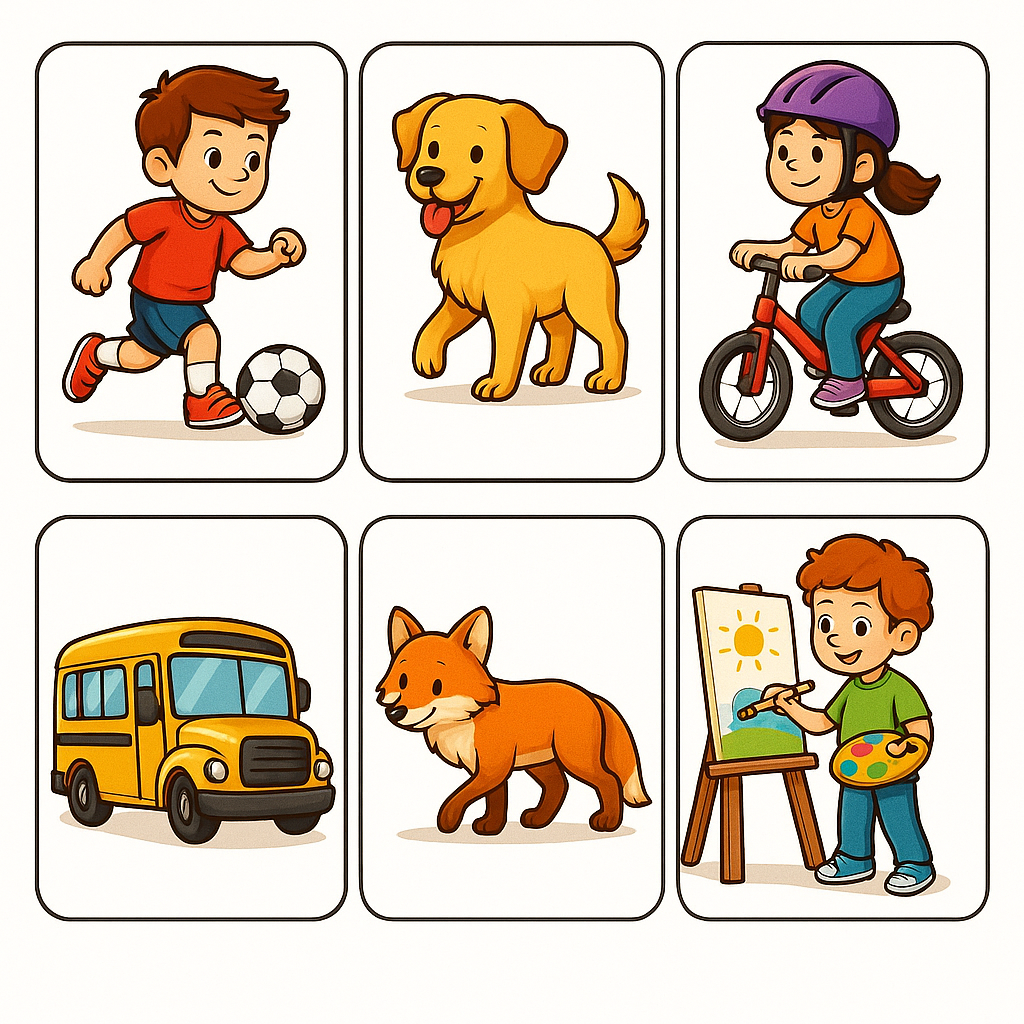
Traditional flashcards teach vocabulary:
💡 The child names the picture
🔹 …and the learning stops there
But language is not vocabulary.
Language is connections.
The “Who / What Does What?” format forces the brain to connect:
Who?
(a person, animal, character)What action?(the verb)
This naturally produces a complete sentence:
• “The dog runs.”
• “The girl eats.”
• “The baby sleeps.”
• “The boy reads.”
For a child stuck at single-word speech, this is a breakthrough.
Why it works so well:
💡no grammar teaching
💡 no rules to memorize
💡 no pressure
💡 no worksheets filled with text
💡 only meaningful Who + Action pairs
Children don’t feel like they’re doing “speech work.”
They feel like they’re describing what they see.
And that is how authentic language begins.
🌟Hidden Magic: Grammar Without Teaching Grammar
You don’t need grammar lessons.
You don’t need complicated “why” worksheet explanations.
You don’t need to force repetition.
This activity teaches:
💡sentence structure
💡 verb usage
💡 correct word order
💡 expressive language
💡 storytelling skills
💡 reasoning and sequencing
…without saying a word about grammar!
A simple interaction like:
👩 “Who is it?”
👦 “The boy.”
👩 “What does he do?”
👦 “Kicks ball.”
👩 “Say the whole sentence.”
👦 “The boy kicks the ball.”
This is how expressive language grows — naturally, visually, gently.
🧠Perfect For:
💡
Pre-K learners
💡
Worksheets for kindergartners
💡
ESL(English as a Second Languagelearners)and bilingual students
💡
Late talkers
💡
Autistic / AAC users(AAC - children or adults who useAugmentative and Alternative Communicationsystems)
💡
Children with apraxia or articulation disorders
💡
Home-learning families
💡
Speech therapists focusing on “WH questions” for speech therapy
The Who + Action format works for every developmental level.
Even non-verbal kids can participate by pointing or choosing.
🔹The Real Problem: Quality Materials Are Hard to Find
Parents and teachers search online for:
• wh questions
• who what questions
• childrens worksheets
• worksheets for Pre-Kindergarteners (often misspelled online as “worksheets for prek”)
• language experience activities
…but what they find is usually:
🔹blurry clipart
🔹 outdated worksheets
🔹 materials focused only on nouns
🔹 images that don’t match real verbs
🔹 random PDFs with no structure
🔹 worksheets that are boring or confusing
Professionals end up spending hours making their own materials.
Parents buy dozens of files that don’t help.
Children get bored before progress happens.
🚀Meet the AI Worksheet Generator
A tool created for:
💡speech therapists
💡 preschool teachers
💡 kindergarten classrooms
💡 autism and early intervention
💡 ESL (English as a Second Language learners) instructors
💡 parents teaching at home
With one button you can generate:
• who questions
• what questions
• full WH sentence-building worksheets
• picture scenes for speech therapy
• worksheets for kindergartners
• Pre-K language development activities
• children worksheets
• fully visual language experience activities
You choose the topic: animals, daily routines, toys, nature, school, food, etc. — and the AI creates perfect worksheets instantly.
No cutting.
No formatting.
No clipart searching.
No wasted time.
Just print and teach.
🎨What Makes These Worksheets Better Than Flashcards?
Flashcards teach vocabulary.
These worksheets teach sentences.
💡Realistic child-friendly pictures
💡 Clear Who + Action structure
💡 Perfect for speech delay
💡 Works for AAC users (AAC - children or adults who use Augmentative and Alternative Communication systems)
💡 Great for bilingual families
💡 Printable for home or classroom
💡 Reusable for games and centers
Kids love it because it feels like a story.
Parents love it because progress becomes visible.
Speech therapists love it because it’s effective with every group.
🎯How to Use It at Home
Show a picture and ask:
💡 “
Who is it?”💡“What are they doing?”💡“Tell the whole sentence.”
If the child struggles, help them with a structure:
“Dog…”
“…is running.”
Small wins build confidence very fast.
🎓How to Use It in Therapy
These worksheets are ideal for:
• sentence expansion
• answering wh questions
• verb practice
• grammar
• articulation in phrases
• sequencing
• describing pictures
• language experience activities
You can use them for 5-minute warm-ups or full 30-minute sessions.
They work in groups and one-on-one.
🌍For Bilingual and ESL (English as a Second Language learners) Families
Picture-based “WH questions tasks” remove pressure and confusion.
Children don’t “translate.”
They think visually.
This supports both languages without mixing them up — ideal for multilingual families.
🏫How to Use It in the Classroom
Use during:
• morning centers
• partner speaking
• small groups
• ESL (English as a Second Language learners) support
• kinder sentence-building activities
• Pre-K vocabulary units
Children learn to describe what they see — not just label it.
This skill directly increases kindergarten readiness.
🔥Ready to Try It?
Yesterday you were searching for worksheets.
Today — worksheets come to you.
Turn single words into sentences.
Turn frustration into communication.
Turn pictures into real speech.